
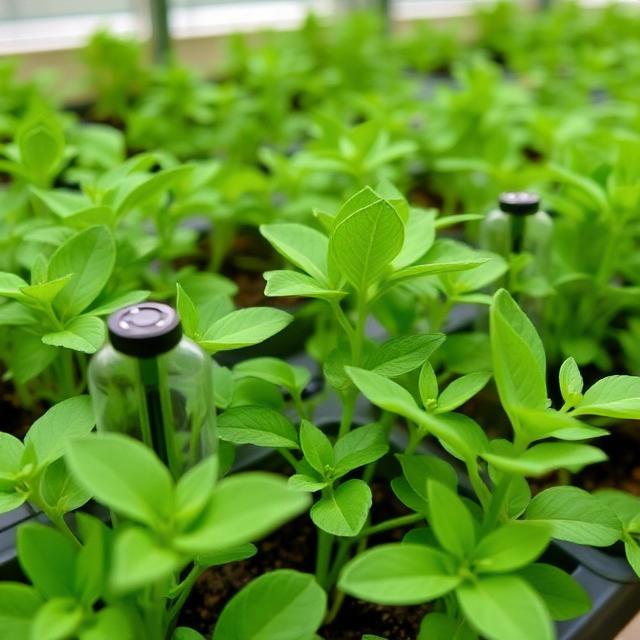
In 2026, “plant parenthood” has evolved from a hobby into a high-tech lifestyle. No longer do we have to rely on the “finger-in-the-dirt” method to see if our Monstera is thirsty.
Smart plant sensors have become the bridge between human intuition and botanical biology, ensuring our indoor jungles thrive with scientific precision.
The Evolution of Plant Care: Key Features of smart plant sensors
Modern smart sensors are far more than just digital thermometers. Today’s leading models focus on four primary pillars of plant health:
[ad] Discover these new trends and visit the WebtechChannel24.com Shop



- Capacitive Moisture Sensing: Unlike older resistive probes that corrode over time, 2026’s top-tier sensors use capacitive technology to measure soil water volume without degrading, providing consistent accuracy within 2%.
- Nutrient & Salinity Monitoring: High-end sensors measure Electrical Conductivity (EC) to tell you exactly when your plant has “eaten” all its fertilizer.
- Environmental Insights: Beyond the soil, these devices track ambient temperature and Light Intensity (measured in PAR—Photosynthetically Active Radiation), which is much more accurate for plant growth than simple lumens.
- AI-Powered Ecosystems: Most sensors now sync with cloud databases containing thousands of plant species, offering tailored push notifications when your specific plant species needs attention.
Top 3 Smart Plant Sensors of 2026 [Smart plant sensor reviews]
| Feature | 1. ThirdReality Soil Sensor | 2. Gardena Smart Sensor | 3. FYTA Beam 2.0 |
| Best For | Smart Home | Outdoor Gardens & Lawns | Interior Design & Detail |
| Connectivity | Zigbee 3.0 | Wi-Fi (via Gardena Gateway) | Bluetooth 5.0 (Wi-Fi via Hub) |
| Measurements | Moisture, Temperature | Moisture, Light, Temp | Moisture, Light, Temp, Nutrients |
| Battery Life | Up to 3 Years (1x AA) | ~1 Year / Season (2x AA) | Up to 2 Years (CR2450 + Solar) |
| Durability | IP67 (Waterproof) | IPX4 (Heavy Weatherproof) | IPX5 (Splashproof) |
| Key Advantage | No proprietary app; local control. | Integrates with irrigation systems. | Interchangeable probe lengths. |
| Price Point | Budget-Friendly | Premium | Mid-Range |
| View latest prices | View latest price | View latest price |
1. FYTA Beam 2.0
The FYTA Beam remains a gold standard for aesthetic and functional design. It is incredibly modular, allowing you to swap out different probe lengths for everything from a tiny succulent to a large floor palm. It tracks moisture, temperature, light, and nutrients, syncing via a sleek Wi-Fi hub that handles dozens of sensors simultaneously.
2. Gardena Smart Sensor
If you have a balcony garden or an outdoor green space, the Gardena Smart Sensor is the rugged choice. It is fully waterproof and designed to withstand extreme temperatures (down to -20°C). It integrates seamlessly with smart irrigation systems, meaning it doesn’t just tell you the plant is dry—it can actually trigger your sprinklers to turn on.
3. ThirdReality Soil Sensor (Zigbee)
For the smart home enthusiast, this sensor is a standout because it uses the Zigbee protocol. It doesn’t require a proprietary app; instead, it connects directly to hubs like Home Assistant or Amazon Echo. With a battery life of up to 3 years, it is the “set it and forget it” king of the market.
Frequently Asked Questions on Smart Plant sensors
How accurate are smart plant sensors compared to manual testing?
Modern specialty sensors utilize AgTech-grade technology that offers precision accuracy within 1.5% to 3%, which is significantly more reliable than standard analog meters or manual touch. These devices measure volumetric water content and electrical conductivity consistently over time, removing the variability caused by human error or different soil types. This high level of precision allows for proactive care, identifying plant stress before physical symptoms like yellowing leaves appear.1
Can one smart sensor be used for multiple plants?
While you can move a sensor between pots to get a “snapshot” reading, the true benefit of smart sensors comes from continuous, 24/7 monitoring of a single plant’s environment.2
Constant data allows the AI to track historical growth patterns and environmental shifts, which is lost when the sensor is frequently unplugged. For the best results, it is recommended to have a dedicated sensor for your most “finicky” or expensive plants.
Do these sensors work in all types of soil and growth media?
Most smart sensors are optimized for standard potting soil, but advanced capacitive models are also effective in specialty media like orchid bark or coco coir. However, very airy or chunky substrates can sometimes create air pockets around the probes, which might lead to “dry” readings even if the medium is damp.3
To ensure accuracy, the sensor must be placed firmly within the root zone where it has consistent contact with the moisture-retaining elements of the substrate.
Sources
- Krado (Plant Sensors 101) ↩︎
- FYTA (The Smart Plant Care) ↩︎
- Farmonaut (Best Moisture Meter for Plants 2026) ↩︎

![Five Amazon KDP mistakes that you should avoid [TUTORIAL]](https://www.webtechchannel24.com/Blog/wp-content/uploads/2022/02/new4-1024x576.jpg)